




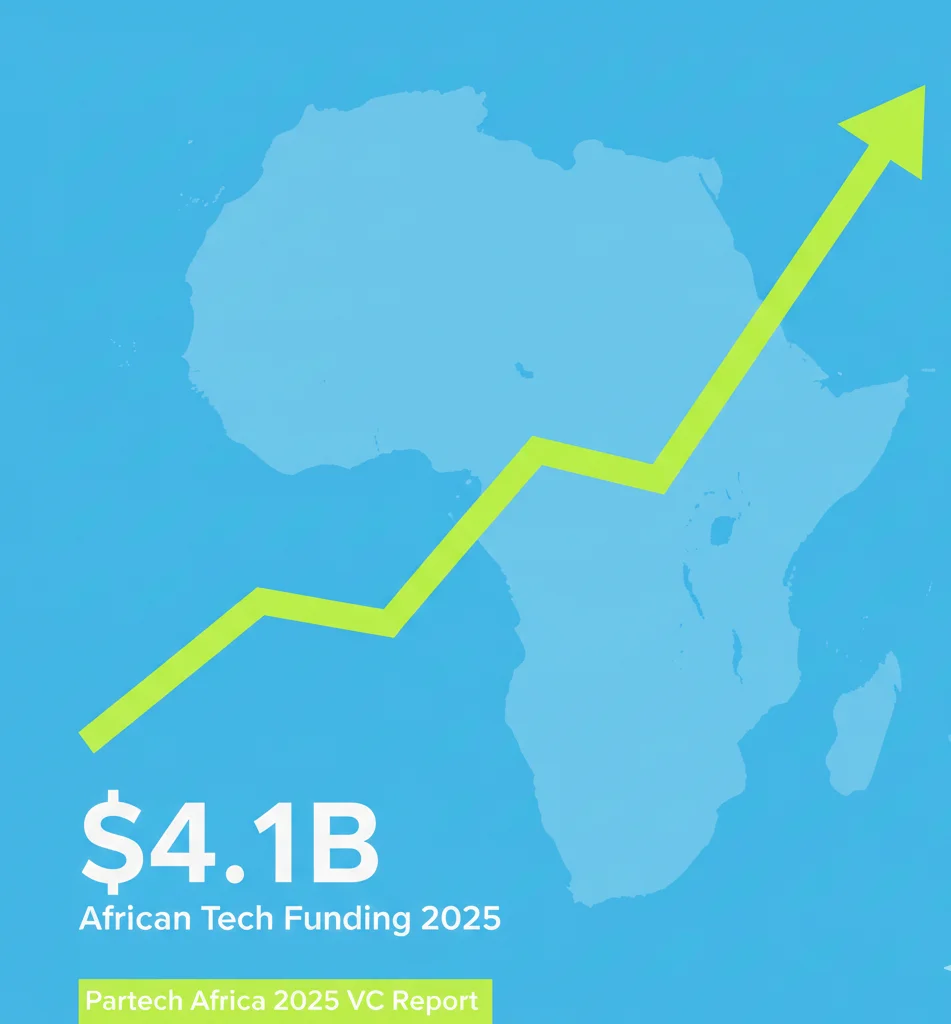
African startups raised $4.1 billion in 2025, marking a strong comeback after two years of decline and the continent’s best funding performance since 2022, according to the Partech Africa 2025 Africa Tech VC Report. The total represents a 25% increase from the $3.25 billion recorded in 2024—but the drivers of the rebound point to a more disciplined, structural shift rather than a return to the exuberance of 2021.
Debt, Not Equity, Powers the Surge
The headline figure blends equity and debt, and the growth is largely debt-led. While equity funding rose a modest 8% year-on-year to $2.4 billion across 462 deals (deal count up just 1%), debt financing hit a record $1.64 billion, jumping 63% and accounting for 41% of all capital deployed in 2025. By contrast, debt made up just 17% of funding in 2019.
Partech says debt has become a “structurally embedded financing layer” for African tech—signaling maturing business models and revenue predictability, not a sudden swing back to risk-on sentiment.
Four Markets Still Dominate—With Shifting Dynamics
Funding remains concentrated in Kenya, South Africa, Egypt, and Nigeria, which together captured 72% of total capital and 68% of deals in 2025. Within that group, however, leadership changed:
- Kenya topped the continent with $1.04 billion (+72% YoY), driven by debt-heavy megadeals—four of Africa’s nine megadeals accounted for about $610 million.
- South Africa led in equity funding for the first time since 2017, raising $643 million (+41%) across 85 rounds (+27%), with growth spread broadly rather than concentrated in a single outlier.
- Egypt maintained a high-velocity pipeline with 100 deals (+4%) and rising ticket sizes.
- Nigeria recorded a pullback—equity down 21% and deal count down 19%—reflecting normalization after a megadeal-heavy peak, not a market collapse.
Fintech Leads, but the Ecosystem Widens
Fintech remained the largest sector with $1.49 billion across 150 deals, but its share of equity funding fell sharply—from 60% in 2024 to 32% in 2025—as other sectors gained traction.
Cleantech was the standout, nearly doubling to $1.18 billion (+99%). Enterprise software ($274 million), e-commerce ($312 million), and healthtech ($224 million) each surpassed $200 million in annual equity for the first time since the 2021–2022 boom, pointing to stronger fundamentals and investor conviction beyond fintech.
The Quiet Concern: Seed Funding
Beneath the recovery, the Seed pipeline continues to thin. Seed deal count dipped 1% to 311 rounds, down 38% from the 2022 peak, while Seed capital fell 4% to $462 million. Conversion remains challenging: only 5.1% of 2021 Seed startups raised Series A within two years; for the 2022 cohort, it was 4.2%. Early signs of improvement are emerging for 2023–2024 cohorts, but the bar remains high.
AI Is There—Just Not Labeled
AI investment is embedded across categories rather than tracked as a standalone vertical. Startups applying AI to credit scoring, fraud detection, health diagnostics, logistics, and SME tools raised meaningful capital in 2025—but are classified under fintech, healthtech, or enterprise. Africa’s AI funding exists; it’s simply priced into other sectors.
Bottom Line
The 2025 rebound reflects measured recovery, not a boom. Equity markets are stabilizing, debt is now a core pillar, and sector breadth is improving. The next phase will hinge on whether early-stage funding can recover fast enough to replenish Series A and B pipelines in the years ahead.