





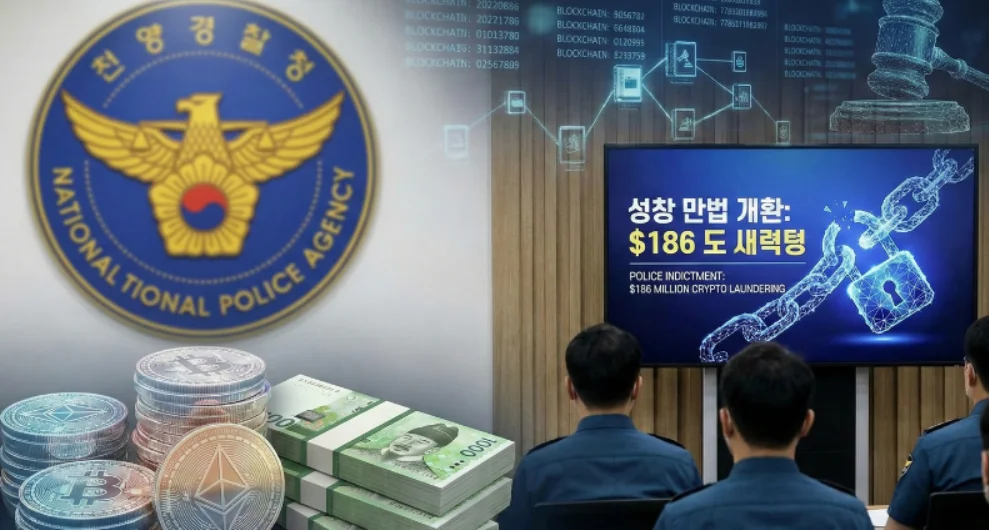
South Korean authorities have indicted two senior police officers for allegedly taking bribes from operators of a massive illegal cryptocurrency exchange involved in laundering $186 million (249.6 billion won) connected to widespread voice-phishing crimes.
The indictment, announced by the Suwon District Prosecutors’ Office Criminal Division, has raised alarm over corruption within law enforcement and the growing exploitation of digital assets by organised crime groups.
Illicit Crypto Network Laundered Millions Through Fraudulent Shops
Investigators say the criminal organisation ran a network of cash-to-crypto outlets disguised as legitimate gift-certificate stores across prominent areas of Seoul, including Gangnam and Yeoksam-dong.
Between January and October 2024, these operators converted stolen voice-phishing proceeds into cryptocurrencies, primarily USDT stablecoins, to obscure the origins of the money and make it appear legitimate.
The operation was exposed after prosecutors re-examined a voice-phishing case initially handled by police, uncovering inconsistencies and a suspicious decision not to charge a key executive. This discovery led to a deeper investigation that unravelled the wider laundering network.
Indicted Officers Accused of Leaking Confidential Information
The police officers charged include:
- A former Seoul police station chief, identified as “F”, who allegedly accepted $59,000 in bribes between July 2022 and February 2024.
- A senior officer identified as “G”, accused of taking $7,500 in cash and luxury items.
Both officials have been dismissed from their positions.
According to prosecutors, the officers were not passive beneficiaries, they actively assisted the criminals by:
- Providing confidential investigation updates
- Helping unfreeze accounts linked to illegal funds
- Connecting suspects to legal support
- Introducing them to other law-enforcement personnel
The revelations have triggered public backlash and renewed scrutiny of police oversight.
Voice-Phishing Remains a Major Criminal Threat in South Korea
Voice-phishing has escalated into a major criminal industry, with syndicates operating both within South Korea and internationally. These groups routinely leverage crypto assets to move illicit funds quickly and discreetly, making detection more challenging.
Despite tougher penalties and improved global cooperation, this case highlights vulnerabilities in law-enforcement structures that fraudsters continue to exploit.
Authorities Freeze $1.1 Million as Investigation Deepens
Prosecutors have frozen around $1.1 million in illicit assets tied to the scheme, including $600,000 worth of USDT. They believe at least $8.4 million (11.2 billion won) in criminal proceeds is still unaccounted for and may have been hidden or spent.
This case forms part of a broader crackdown on crypto-related crimes. In early 2025, South Korea established a specialised virtual-asset crime investigation unit to address the rising complexity of such offenses.
Public Trust Shaken as Calls for Independent Probe Intensify
The involvement of senior police officials has severely damaged public confidence. Civil-society groups and opposition leaders are demanding a fully independent investigation and stronger internal controls within the police force.
They warn that corruption at this level erodes progress in fighting financial crime and regulating the digital-asset landscape.
Prosecutors, however, argue the case shows their commitment to transparency, emphasising that no individual is exempt from legal accountability. More arrests may follow as the investigation widens.
A Critical Reminder of Crypto’s Risks in Financial Crime
This scandal highlights the dangerous intersection of digital assets and organised crime, particularly when law-enforcement personnel become collaborators instead of investigators.
The case underscores the ongoing need for:
- Stricter anti-money laundering protocols
- Greater transparency in crypto transactions
- Stronger oversight and accountability among law-enforcement agencies
Details on trial dates and potential sentencing are expected in the coming months.